

Key Point:
- California recognizes two types of workplace sexual harassment, quid pro quo and hostile work environment, under FEHA and Title VII.
- To prove a claim, you generally show unwelcome conduct based on sex that was severe or pervasive (or tied to a job benefit) and that the employer knew or should have known about it.
- Employers are strictly liable for supervisor harassment, and a sexual harassment attorney can help you act on it.
If you’ve ever booted up a computer before clocking in, finished tasks after clocking out, or answered work messages at home without pay, you may have worked “off the clock,” and in California, that time is almost always compensable. Here’s when off-the-clock work crosses into an unpaid wages claim you can pursue.
Workplace sexual harassment remains one of the most under-reported and most damaging violations employees face. California offers some of the strongest protections in the country, and several 2026 rules strengthen them further. Here’s the framework for understanding and proving a claim.
How Do You Prove Sexual Harassment in the Workplace?
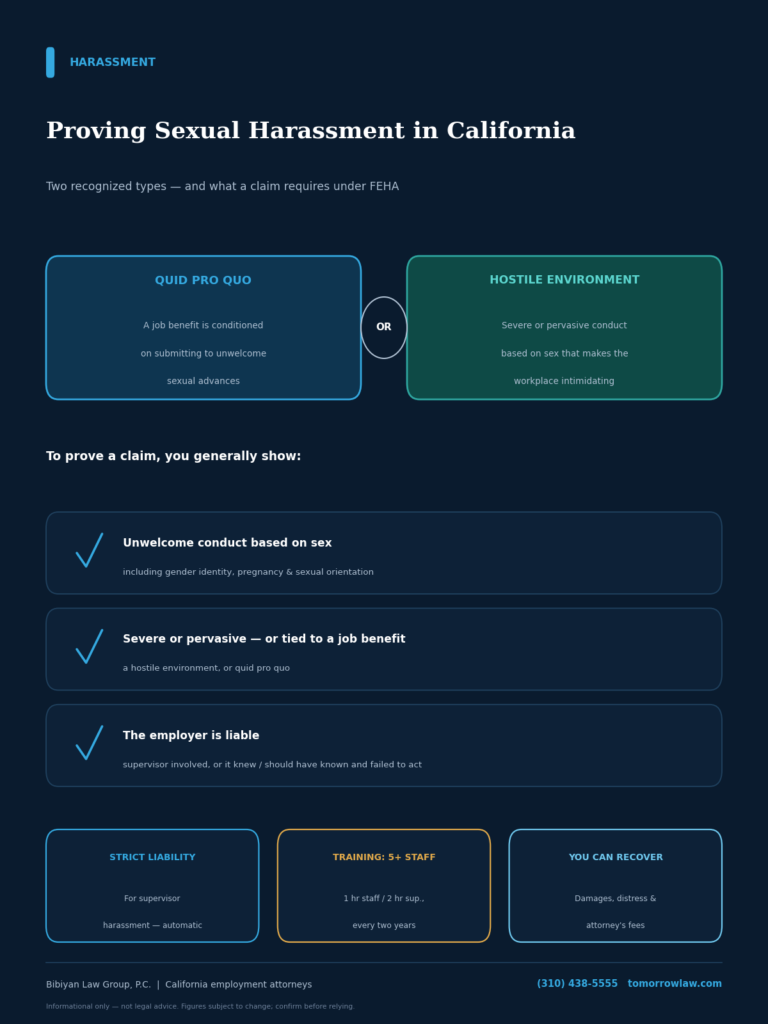
To prove workplace sexual harassment in California, you generally need to show:
- Unwelcome conduct based on sex (which includes gender, gender identity, pregnancy, and sexual orientation),
- The conduct was either severe or pervasive enough to create a hostile environment, or was tied to a job benefit (quid pro quo), and
- The employer is liable because a supervisor was involved or because the employer knew or should have known about coworker or third-party conduct and failed to act.
Evidence often includes documentation (texts, emails, messages), a record of when and how you reported it, witness statements, and a timeline showing the conduct and any retaliation that followed.
The Two Types of Sexual Harassment
Quid pro quo (“this for that”) occurs when a supervisor or someone with authority conditions a job benefit, like a promotion, raise, schedule, or continued employment, on submitting to unwelcome sexual advances.
Hostile work environment arises when unwelcome conduct based on sex is severe or pervasive enough to create an intimidating, hostile, or offensive workplace. It can include unwanted touching, comments, jokes, messages, or displays, and can come from supervisors, coworkers, or even non-employees like clients. Our guide on filing a lawsuit for a hostile work environment in Los Angeles covers this in more detail.
Key Legal Framework in 2026
Several features define California’s protections:
- Employer liability: Employers are strictly liable for harassment by supervisors. For harassment by coworkers or non-employees, the employer can be liable if it knew or should have known and failed to take immediate corrective action.
- Mandatory training: California requires all employers with five or more employees to provide sexual harassment prevention training, one hour for non-supervisory employees and two hours for supervisors, every two years.
- Confidentiality protections: The “Silenced No More Act” and related measures severely restrict the use of non-disclosure agreements (NDAs) in settlement agreements involving workplace harassment or assault, so survivors are not silenced as a condition of resolution.
How to Protect Your Claim
- Document everything: dates, times, locations, what was said or done, and who witnessed it.
- Report it through your employer’s complaint process if it is safe to do so, and keep copies of your reports and any responses.
- Preserve evidence before it disappears, screenshots, emails, and messages.
- Watch for retaliation. Being punished for reporting harassment is itself illegal and can strengthen your case.
Filing and Deadlines
Sexual harassment claims under FEHA generally require filing an administrative complaint with the California Civil Rights Department (CRD) before suing, and strict deadlines apply. (See our companion guide on the FEHA statute of limitations for the 2026 timing rules.) Because deadlines can bar even strong claims, talk to a lawyer early.
What You Can Recover
Survivors may recover compensatory damages (including for emotional distress), punitive damages in egregious cases, and attorney’s fees. Courts can also order the employer to change policies and training. Every case is different; an attorney can help you understand the potential value of yours.
What You Can Do
- Save evidence and write down the timeline.
- Know your rights to report without being retaliated against.
- Talk to a sexual harassment attorney in a free, confidential consultation.
How Bibiyan Law Group Can Help
Coming forward takes courage, and the right advocate handles your case with both discretion and determination. Our California sexual harassment attorneys can:
- Help you preserve evidence and document your reports before anything disappears;
- Navigate the CRD filing and the strict deadlines that apply;
- Protect you from retaliation, which is itself unlawful and can strengthen your claim; and
- Pursue compensation with the confidentiality protections of the Silenced No More Act on your side.
Speak With Our Team Confidentially
Coming forward about workplace sexual harassment takes courage, and you deserve an advocate who treats your case with both discretion and determination. Our California employment attorneys can help you preserve evidence, document your reports, navigate the CRD filing and deadlines, and pursue compensation while protecting you from retaliation, with the confidentiality protections of the Silenced No More Act on your side. We represent employees only, never employers, and we work on a contingency basis: your consultation is free and confidential, and you owe no attorney’s fee unless we recover for you. Contact us or call (310) 438-5555 to speak with our team privately.
Frequently Asked Questions
How do you prove sexual harassment in the workplace?
You generally show unwelcome conduct based on sex that is either severe or pervasive (creating a hostile environment) or tied to a job benefit (quid pro quo), and the employer is liable, through supervisor involvement or by knowing about the conduct and failing to act. Documentation, reports, witnesses, and a timeline support the claim.
What are the two types of sexual harassment in California?
Quid pro quo, where a job benefit is conditioned on submitting to unwelcome sexual advances, and hostile work environment, where unwelcome conduct based on sex is severe or pervasive enough to create an intimidating or offensive workplace.
Is an employer automatically responsible for harassment?
Employers are strictly liable for harassment by supervisors. For coworker or non-employee harassment, the employer is liable if it knew or should have known and failed to take immediate corrective action.
Does California require sexual harassment training?
Yes. Employers with five or more employees must provide sexual harassment prevention training, one hour for non-supervisory employees and two hours for supervisors, every two years.
David Bibiyan, Esq. is the founding attorney of Bibiyan Law Group, P.C., also operating as Tomorrow Law. He is a member of the California State Bar. He has dedicated his career exclusively to representing California employees, never employers, in wrongful termination, discrimination, harassment, retaliation, and wage and hour matters. Under his leadership, the firm has recovered more than $400 million in settlements and verdicts for workers across Los Angeles, Orange County, San Diego, San Francisco, Sacramento, and throughout California. The firm’s attorneys practice before the California Civil Rights Department, the Division of Labor Standards Enforcement, and state and federal courts across California.
View Full Attorney Profile and Credentials
Related Blog Posts
- What Is Constructive Discharge?
- Can You File a Lawsuit for a Hostile Work Environment in Los Angeles?
- I Am Feeling Discriminated Against at Work, Can I Sue?
- What Is the Difference Between Laid Off and Terminated in California?
- Average Wrongful Termination Settlement Amounts in California
This article is general information and not legal advice. Reading it does not create an attorney-client relationship. This is a sensitive topic; if you need support, help is available. Bibiyan Law Group P.C. also operates as Tomorrow Law.
Disclaimer: This is for informational purposes only and does not constitute legal advice. It does not create an attorney-client relationship. Legal results are not guaranteed and vary by case. Bibiyan Law Group P.C. also operates as Tomorrow Law.

David Bibiyan, a top attorney at Tomorrow Law™, specializes in employment law, fiercely defending employees in cases of discrimination, harassment, wrongful termination, and wage issues. Known for his deep legal knowledge and dedication, he consistently secures favorable outcomes through skillful negotiation and litigation. His passion for justice drives his commitment to workers’ rights and fair employment practices.