

Written by David Bibiyan — Principal Attorney, Bibiyan Law Group, P.C.
(UCLA Graduate, J.D., The University of Chicago Law School, Admitted to the California Bar)
California law sets no single legal cutoff for full-time work. In practice, 40 hours a week is the common benchmark, and anything below that is often treated as part-time, but your employer’s policy usually decides where the line falls. Why it matters: your classification can affect your overtime, benefits, and sick-leave rights, even though many core protections stay the same.
If your hours, pay, or benefits do not line up with your classification, talk it through with a California unpaid wages attorney at Bibiyan Law Group in a free consultation.
What Is Considered Full Time in California?
There is no universal statutory definition of full-time employment in California for all purposes. The most common reference point is 40 hours a week, which California Labor Code section 515 and state guidelines use as the standard full-time workweek, especially when calculating the salary threshold for exempt employees. But California law does not force employers to treat 40 hours as the dividing line for every purpose, and it does not require employers to provide benefits to full-time workers at all. Whether you are full-time for benefits usually comes down to your employer’s internal policy or your employment contract. For how classification works more broadly, see our overview of employment status.
How Many Hours Is Full Time in California?
For most everyday purposes, employers treat 40 hours a week as full-time, and many tie benefits eligibility to a weekly-hours threshold they set themselves. Because the state does not lock in a single number, you can have two employers that classify the same 36-hour schedule differently. The practical takeaway: the number on your schedule matters less than how your employer classifies you, and whether that classification is being applied fairly rather than used to withhold pay or benefits you have earned.
What Is Full Time in California Under Federal Benefit Laws?
Federal benefit laws define full-time differently depending on the program, which is why the answer shifts with the context:
- Affordable Care Act (ACA): For health coverage rules, the ACA treats an employee averaging at least 30 hours a week, or 130 hours a month, as full-time. Larger employers, those with 50 or more full-time or full-time-equivalent employees, generally must offer health coverage to their full-time staff.
- ERISA and retirement plans: Retirement-plan eligibility uses its own hours-based tests rather than a 40-hour rule, so some long-term part-time workers can become eligible to participate even without full-time hours.
The point is that “full-time” is not one fixed number. It depends on which law or program you are looking at, and an employer’s internal definition does not override a federal threshold where one applies.
Full-Time Rights and Common Benefits
Full-time employees in California often receive some or all of the following, depending on employer policy: health insurance, vacation time, sick leave, holiday pay, parental leave, paid personal days, retirement plans, a fixed schedule, and protection against discrimination, harassment, and wrongful termination.
One correction worth making, since it is widely misunderstood: in California, employers must pay most non-exempt employees overtime, whether they are full-time or part-time. Overtime turns on exempt versus non-exempt status, not on the full-time label. A non-exempt worker generally earns time and a half past 8 hours in a day or 40 in a week, and double time past 12 in a day. If your overtime has not been paid correctly, a Los Angeles overtime violations lawyer can review your pay.
Part-Time Rights
Part-time workers keep the same core legal protections as full-time workers, including minimum wage, overtime when they cross the daily or weekly limits, meal and rest breaks, paid sick leave once eligible, and freedom from discrimination and harassment. What usually differs is supplementary benefits like health insurance, paid vacation, and retirement, which are often limited or prorated for part-time staff.
Rights That Are the Same for Both
Regardless of how many hours you work, California law gives every worker the same floor of protections. Both full-time and part-time employees are entitled to at least the applicable minimum wage, which rose again statewide at the start of 2026. Both are entitled to overtime if they are non-exempt and cross the limits, to meal and rest breaks, to paid sick leave once eligible, and to a workplace free from discrimination, harassment, and retaliation under the Fair Employment and Housing Act. A California workplace discrimination lawyer can help if those protections are denied.
Full-Time vs Part-Time: What Changes and What Does Not
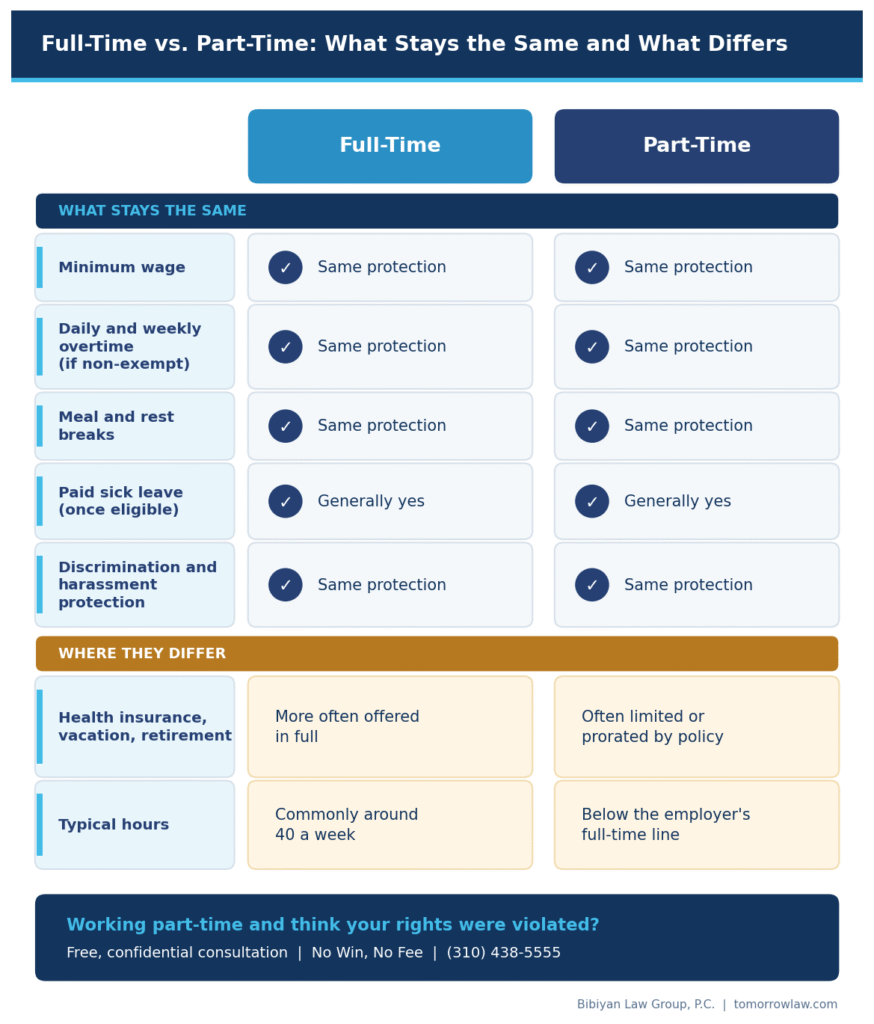
The pattern is simple. Core wage, hour, and anti-discrimination rights do not depend on your hours. Supplementary benefits are where full-time and part-time status usually diverge.
Common Employment Violations for Both Categories
Some violations hit full-time and part-time workers alike:
- Misclassification. If your employer calls you an independent contractor or part-time worker but schedules you for full-time hours and duties, you may have a misclassification claim worth reviewing.
- Wage theft. This includes failing to pay for all hours worked, not paying proper overtime rates, and not providing legally required meal and rest breaks.
- Discrimination. The Fair Employment and Housing Act protects both full-time and part-time employees from workplace discrimination and harassment.
No worker should have to accept illegal treatment. If you believe your employer has crossed the line, an experienced employment attorney at Bibiyan Law Group can review your situation and help you decide the best next step.
A Closer Look: An Anonymized California Example
Consider a hypothetical worker in Southern California hired as “part-time” but regularly scheduled for 45 hours a week doing the same duties as full-time staff, while being denied health benefits tied to full-time status and paid a flat rate with no overtime. On paper the label says part-time. In reality the hours and duties look full-time, and the missing overtime and benefits may point to misclassification. One busy week might be nothing. A steady pattern is worth a closer look.
If that sounds like your situation, a free case review can tell you where you stand. Reach out to Bibiyan Law Group to get started.
How Bibiyan Law Group Helps
At Bibiyan Law Group, we focus on employment law and represent workers across Los Angeles, Southern California, and Northern California. We combine real compassion for hard-working employees with a drive to hold employers accountable, whether the issue is misclassification, unpaid overtime, denied benefits, or discrimination. Our team will review your situation, explain your options in plain terms, and advocate for the outcome you deserve.
Take the first step. Contact Bibiyan Law Group to book your free consultation today.
Sources
- Cal. Lab. Code § 515, Exemptions; Full-Time Employment, https://leginfo.legislature.ca.gov/faces/codes_displaySection.xhtml?lawCode=LAB§ionNum=515.
- Cal. Lab. Code § 510, Day’s Work; Overtime, https://leginfo.legislature.ca.gov/faces/codes_displaySection.xhtml?lawCode=LAB§ionNum=510.
- Cal. Dep’t of Indus. Relations, Overtime, https://www.dir.ca.gov/dlse/faq_overtime.htm.
- U.S. Internal Revenue Serv., Identifying Full-Time Employees (ACA), https://www.irs.gov/affordable-care-act/employers/identifying-full-time-employees.
- Cal. Dep’t of Indus. Relations, 2026 Minimum Wage, https://www.dir.ca.gov/dlse/minimum_wage.htm.
Frequently Asked Questions
Is 32 hours full-time in California?
Not by any fixed law. California does not set a universal cutoff, so 32 hours may be full-time at one employer and part-time at another. Benefits eligibility usually turns on the threshold your employer sets.
Can an employer deny benefits to full-time workers in California?
California generally does not require employers to provide benefits like health insurance or vacation. Eligibility is set by employer policy or contract, though federal rules like the ACA can require larger employers to offer health coverage to full-time staff.
Do full-time employees automatically get overtime?
No. Overtime depends on whether you are non-exempt, not on being full-time. Non-exempt workers get overtime past the daily or weekly limits; properly classified exempt employees do not.
Is part-time or full-time better for legal protections?
Core protections are the same. Minimum wage, overtime for non-exempt workers, breaks, sick leave, and anti-discrimination rights apply to both. The difference is mainly in supplementary benefits.
Can my employer change me from full-time to part-time?
Employers can generally adjust schedules, but not to retaliate against you or to strip pay and benefits you have already earned. If the change followed a complaint, it is worth reviewing.
Does California use the ACA 30-hour rule for everything?
No. The 30-hour rule is specific to ACA health-coverage obligations. Other purposes, like exempt-salary calculations, use the 40-hour full-time standard instead.
This article is provided for general information only and is not legal advice. Reading it does not create an attorney-client relationship. Results described are not a guarantee or prediction of the outcome of any other matter. Laws change, and every case is different, so speak with a qualified employment lawyer about your specific situation.

David Bibiyan, a top attorney at Tomorrow Law™, specializes in employment law, fiercely defending employees in cases of discrimination, harassment, wrongful termination, and wage issues. Known for his deep legal knowledge and dedication, he consistently secures favorable outcomes through skillful negotiation and litigation. His passion for justice drives his commitment to workers’ rights and fair employment practices.