


Written by David Bibiyan — Principal Attorney, Bibiyan Law Group, P.C.
(UCLA Graduate, J.D., The University of Chicago Law School, Admitted to the California Bar)
Key Point:
- In California, non-exempt employees denied a compliant meal or rest break are owed one extra hour of pay (a premium) at their regular rate for each type of break violated per workday.
- In 2026, meal and rest break premiums must be calculated on your full regular rate of pay, including non-discretionary bonuses and commissions, not just your base wage.
- Unpaid premiums stack quickly and are a common basis for unpaid wage and class action claims.
If you regularly skip lunch, eat at your desk while working, or never get a real break during a long shift, California law may already owe you money for it. The rules around meal and rest break premiums are some of the strongest in the country, yet break violations remain one of the most common wage problems we see at Bibiyan Law Group. This guide explains exactly what you are owed in 2026 and how the premium payment works.
Think your employer has denied you legally required breaks? You may be owed one to two hours of premium pay for every affected shift. Contact Bibiyan Law Group for a free consultation to find out what your missed breaks are worth.
From our practice: In the wage and hour cases we handle, missed-break premiums are the most commonly overlooked wages. Workers rarely track them, and employers rarely pay them without a claim. When we pull pay stubs and time records, the unpaid total is frequently in the thousands.
What California Requires for Meal and Rest Breaks
Under the California Labor Code, non-exempt employees are entitled to:
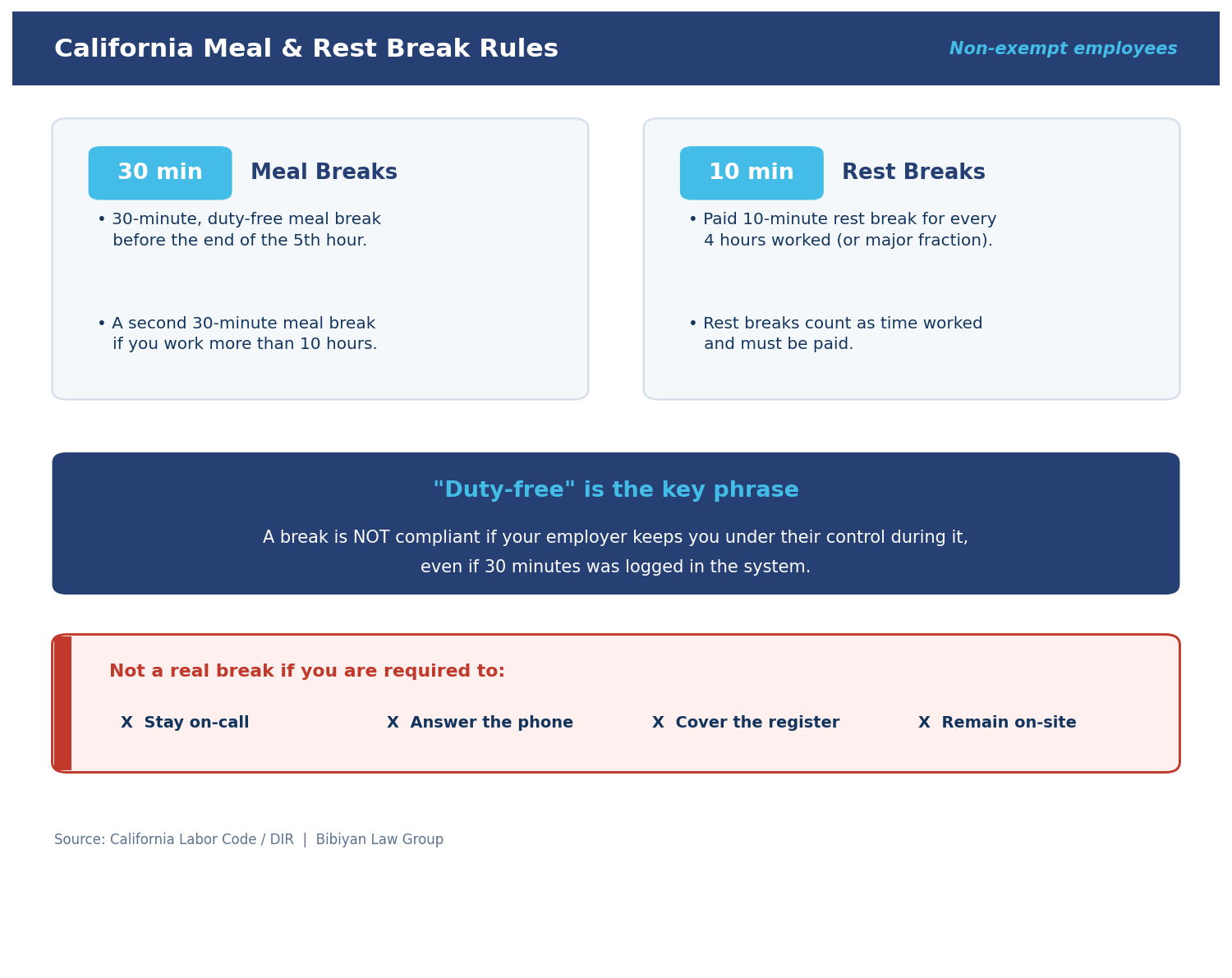
- A 30-minute, duty-free meal break before the end of the fifth hour of work. If you work more than 10 hours, you are entitled to a second 30-minute meal break.
- A paid 10-minute rest break for every four hours worked or major fraction thereof. Rest breaks count as time worked and must be paid.
“Duty-free” is the key phrase. If your employer requires you to stay on-call, answer the phone, cover the register, or remain on-site under their control during your meal period, it is not a compliant break, even if they logged 30 minutes in the system.
 What Is the Meal Penalty in California in 2026?
 What Is the Meal Penalty in California in 2026?
When an employer fails to provide a compliant meal or rest period, they owe a premium payment of one additional hour of pay at the employee’s regular rate. This is often called the meal penalty or rest break premium.
Here is how meal and rest break premiums work in 2026:
- One hour of premium pay per workday for meal violations and a separate one hour of premium pay per workday for rest violations. A single bad shift can generate up to two hours of premium pay.
- The premium is calculated on your regular rate of pay, which under current California law includes non-discretionary bonuses, commissions, and shift differentials, not just your base hourly rate. If your pay includes those extras, your premium should be higher than your base wage.
How These Meal and Rest Break Premiums Add Up
A single missed break may feel minor. Multiply it across months or years; add a second daily premium for the other break type; recalculate on the full regular rate; and layer in derivative penalties, and a routine break problem can become a significant recovery. The chart below shows how quickly unpaid meal and rest break premiums accumulate.
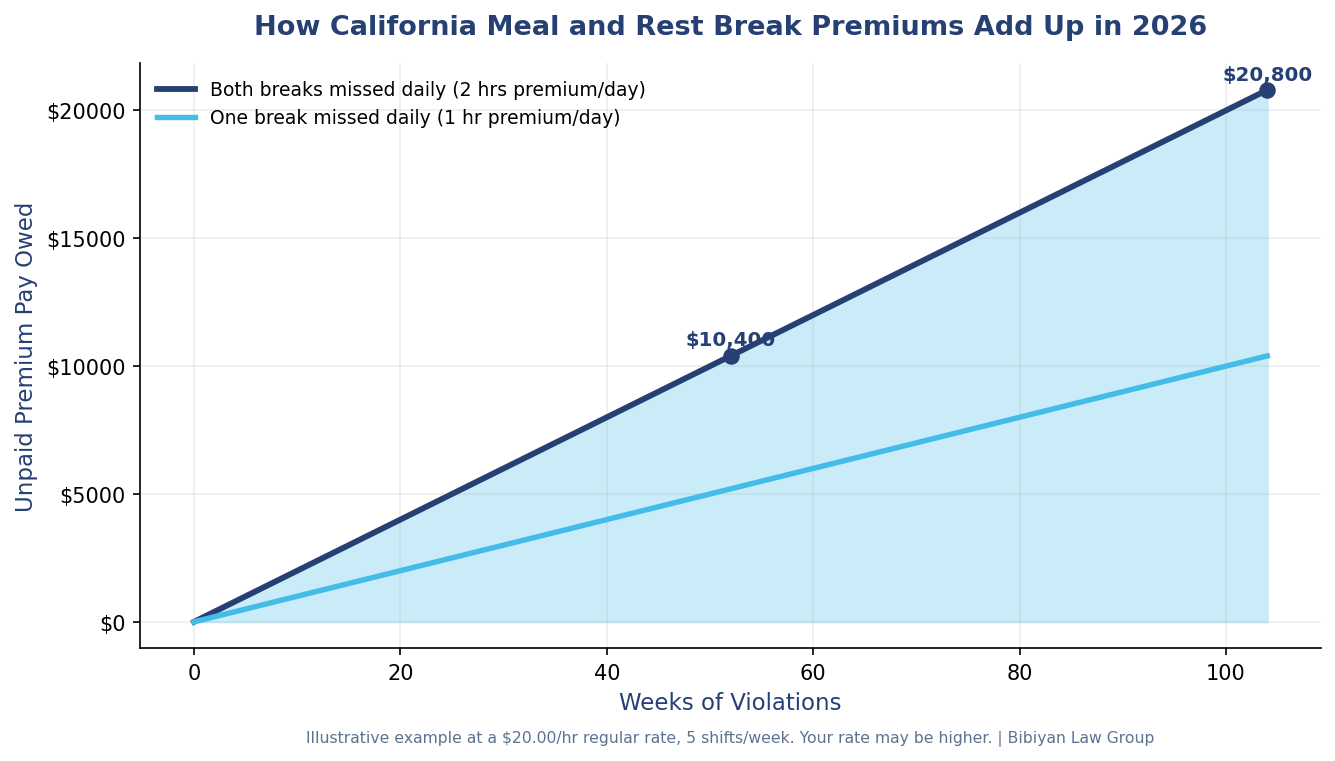 Chart: Unpaid meal and rest break premiums in California compound fast. At a $20.00 regular rate with both breaks missed daily, a worker can be owed over $20,000 within two years.
When the same unlawful policy affects an entire crew, store, or warehouse, it frequently becomes a wage and hour class action.
Do not let your employer keep money you earned. Our attorneys can review your pay stubs and calculate your unpaid meal and rest break premiums at no cost. Schedule your free consultation with Bibiyan Law Group or call (310) 438-5555.
What Does a California Rest Break Premium Mean?
A rest break premium is simply the one-hour payment your employer owes when you were not authorized and permitted to take a compliant paid rest break. It is not a punishment you have to prove in court like damages. It is a wage the employer is required to pay automatically when the break is missed. When employers fail to pay it, those unpaid premiums become recoverable wages, often going back years.
How Many Breaks for an 8-Hour Shift in California?
For a standard 8-hour shift, a non-exempt employee is generally entitled to:
- One 30-minute meal break before the end of the fifth hour, and
- Two 10-minute paid rest breaks, one for the first four hours and one for the second four hours.
If you worked an 8-hour shift and received neither a real lunch nor your rest breaks, you may be owed premium pay for that day, every day it happened.
What You Can Do
- Track your breaks. Note the days you missed a meal or rest period, were interrupted, or were kept on-call.
- Keep your records. Save pay stubs and any timekeeping records that show break patterns.
- Talk to an employment lawyer. A Los Angeles Meal and Rest Periods Lawyer can review your situation, calculate what you may be owed, and tell you whether you have a claim.
For more on break-related wage claims, read our posts on California Meal and Rest Breaks and the California Break Violation Lawyer. To learn more about how the California Labor Commissioner enforces these rules, visit the California DLSE.
Recover the Meal and Rest Break Premiums You Are Owed
Missed break premiums are easy for employers to ignore and easy for employees to overlook, yet they add up fast, especially when the same policy affects an entire crew or shift. Our California employment attorneys can review your pay stubs and schedules, calculate the meal and rest break premiums you are actually owed on your full regular rate, and pursue them through the Labor Commissioner or, where many workers are affected, a wage and hour class action. We represent employees only, never employers, and we work on a contingency basis. Your consultation is free, and you owe no attorney’s fee unless we recover for you.
Contact Bibiyan Law Group or call (310) 438-5555 to find out what your missed breaks may be worth.
Frequently Asked Questions
What is the meal penalty in California in 2026?
The meal penalty is one additional hour of pay at your regular rate for each workday your employer failed to provide a compliant 30-minute meal break. A separate one-hour premium applies to missed rest breaks, so a single day can owe up to two premium hours.
How are meal and rest break premiums calculated in California?
Premiums must be calculated on your full regular rate of pay, which includes non-discretionary bonuses, commissions, and shift differentials, not just your base hourly rate. If your pay includes those extras, your premium is higher than your base wage.
What does a California rest break premium mean?
It is the one hour of pay your employer owes when you were not provided a compliant paid 10-minute rest break. It is a wage owed automatically when the break is missed, not a discretionary penalty.
How many breaks are required for an 8-hour shift in California?
A non-exempt employee on an 8-hour shift is generally entitled to one 30-minute meal break before the end of the fifth hour and two paid 10-minute rest breaks.
How far back can I recover unpaid meal and rest break premiums? You can generally recover unpaid premiums going back three years under the California Labor Code, or up to four years under the Unfair Competition Law. The sooner you act, the more you may be able to recover.
About the Author
David Bibiyan, Esq. is the founding attorney of Bibiyan Law Group, P.C., also operating as Tomorrow Law. He is a member of the California State Bar. He has dedicated his career exclusively to representing California employees, never employers, in wrongful termination, discrimination, harassment, retaliation, and wage and hour matters. Under his leadership, the firm has recovered more than $400 million in settlements and verdicts for workers across Los Angeles, Orange County, San Diego, San Francisco, Sacramento, and throughout California. The firm’s attorneys practice before the California Civil Rights Department, the Division of Labor Standards Enforcement, and state and federal courts across California.
Related Blog Posts
- California Meal and Rest Breaks
- California Break Violation Lawyer
- What Happens If Your Employer Violates California Lunch Break Laws
- Minimum Wage in California 2026
- Maximizing Your Claim: Why a Class Action Lawyer Is Essential for California Employees
Disclaimer: This article is general information and not legal advice. Reading it does not create an attorney-client relationship. Legal results vary by case and are never guaranteed. Bibiyan Law Group P.C. also operates as Tomorrow Law.

David Bibiyan, a top attorney at Tomorrow Law™, specializes in employment law, fiercely defending employees in cases of discrimination, harassment, wrongful termination, and wage issues. Known for his deep legal knowledge and dedication, he consistently secures favorable outcomes through skillful negotiation and litigation. His passion for justice drives his commitment to workers’ rights and fair employment practices.